Emccu today

latest news bar

The Referee in the Machine: How AI Is Quietly Taking Charge of Football`s Biggest Calls 
Dr.hany  (13)

    For as long as football has existed, the referee`s whistle has been the final word, and the source of the game`s most heated arguments. Today a new voice is joining the conversation. It does not shout or run, and it never loses sight of the ball. Artificial intelligence has moved from the edge of the sport to the heart of how matches are managed, and the 2026 World Cup was its biggest stage yet.


    Offside in the Blink of an Eye
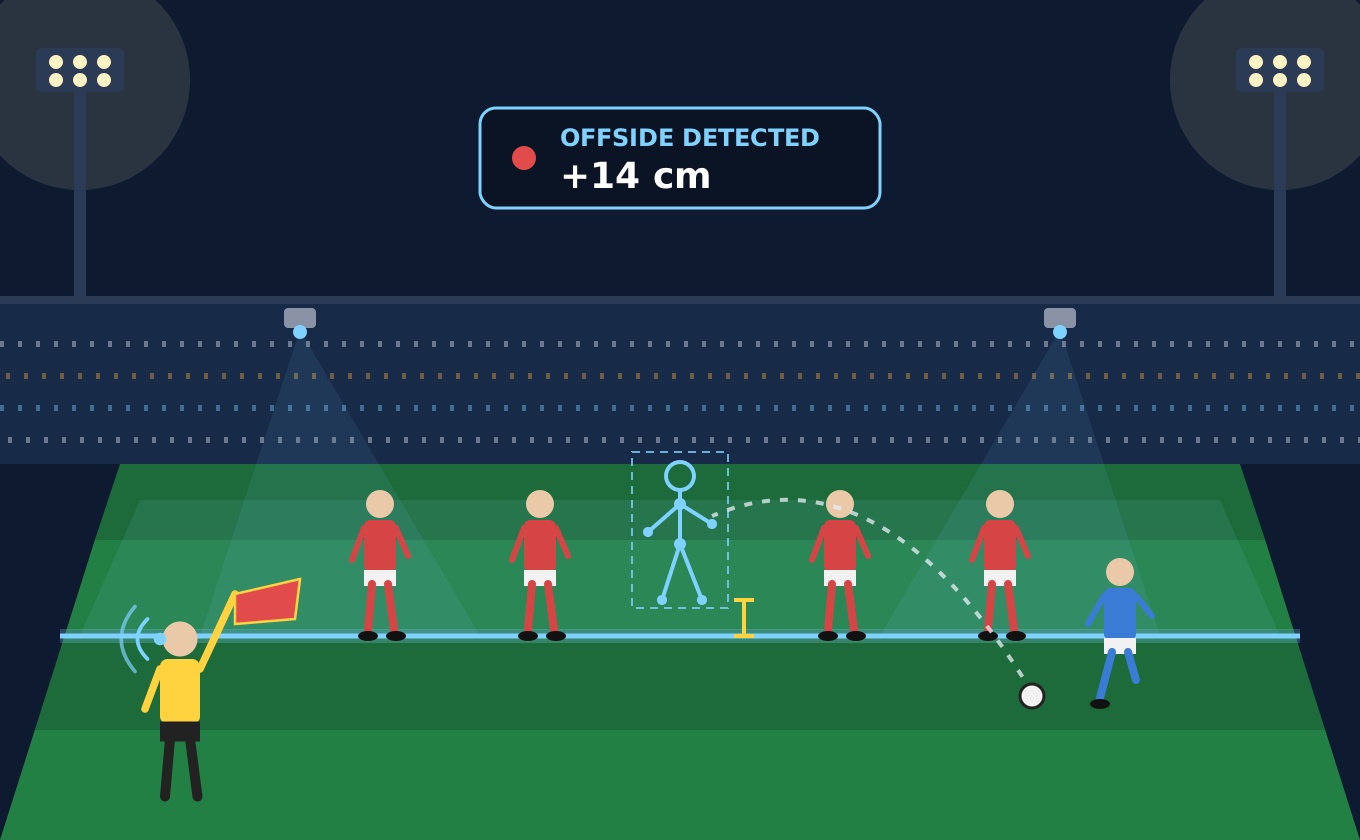
    The clearest example is offside, the rule that has divided fans for generations. At the 2022 World Cup, FIFA introduced semi-automated offside technology, which combines limb and ball tracking with artificial intelligence to give officials information within seconds.


    In 2026, the system took a major step forward. In 2022 the information went to the video assistant referee, but now clear offsides are sent directly to the match officials on the pitch. The sensitivity has changed too. The old system alerted officials when a player was more than 50cm offside; the new one does so at more than 10cm, with an audio alert sent to their earpieces.


    The gain is speed, and with it, safety. FIFA says the upgrade allows faster offside decisions and reduces the injury risk for players in the moments between the offside happening and the flag going up. Fewer plays run on pointlessly, and fewer goals are celebrated only to be chalked off minutes later.


    Every Player Gets a Digital Twin
    To sharpen the system further, FIFA built a digital squad. All 1,248 players across the 48 teams were scanned to create personal AI avatars, so that offside decisions could be more accurate. The avatars are used exclusively for the offside system, giving precise body measurements to improve tracking during assessments. They also make the broadcast replays far easier for fans to follow.


    A Stadium That Sees Everything
    Behind these decisions sits a vast sensing network. Each of the 16 stadiums has 16 optical tracking cameras, producing more than 150 million tracking data points per match. That feed lets FIFA recreate the whole match in 3D for the VAR, which helps in judging whether an offside player is interfering with play, for example by blocking the goalkeeper`s view. The same data can also help officials decide whether the ball crossed the touchline in the build-up to a goal.


    The wider toolkit is broad. According to the University of Rochester, it includes Hawk-Eye technology supporting the VAR, goal-line technology, semi-automated offside and a "last touch" feature for corners and goal kicks. With more than 1.5 billion people expected to watch the finals, every decision is examined at a scale no referee of the past ever faced.

    .

    AI on the Touchline
    The machine is not only helping the officials. Football AI Pro, a post-match analysis assistant powered by hybrid and generative AI, lets users query official match data in plain language and returns tactical insights and performance analysis. FIFA reports that all 48 teams used it.


    The significance lies in fairness. Previously, teams received data reports of 50 or 60 pages for each match, which only well-resourced squads could analyze in depth. FIFA`s technology director argues that the tool can democratize access so that smaller federations are not left behind by richer ones.


    Where the Machine Stops
    For all the excitement, the technology has clear limits. FIFA`s own director of innovation stressed that the improved system covers positional offside only and does not determine whether an offside player interfered with play. That judgment still belongs to humans.


    Experts take the same view. A University of Rochester report puts it plainly: computer vision will not replace referees at the World Cup, but it can help them make better calls when every inch matters. Football also requires decisions that no sensor can make: whether a foul was reckless, whether a player was simulating, or how to calm a match that is about to boil over.


    The Road Ahead
    The same approach is spreading well beyond football. Similar systems already measure first downs in the NFL, call lines at the US Open and rule on goaltending in the NBA. The likely direction in football is a deeper partnership: machines handling measurement and speed, humans handling judgment and context. Questions of transparency, cost and access for leagues without World Cup budgets will matter just as much as accuracy.


    The fans` goal is simple: fewer injustices and fewer long waits. AI may deliver both, but it will not remove the debate that makes football what it is. The whistle still belongs to a human being, and the best version of the future is one in which the machine helps that person see more clearly.

    .

  write acomment


  Comments

Related Posts you may like

short list